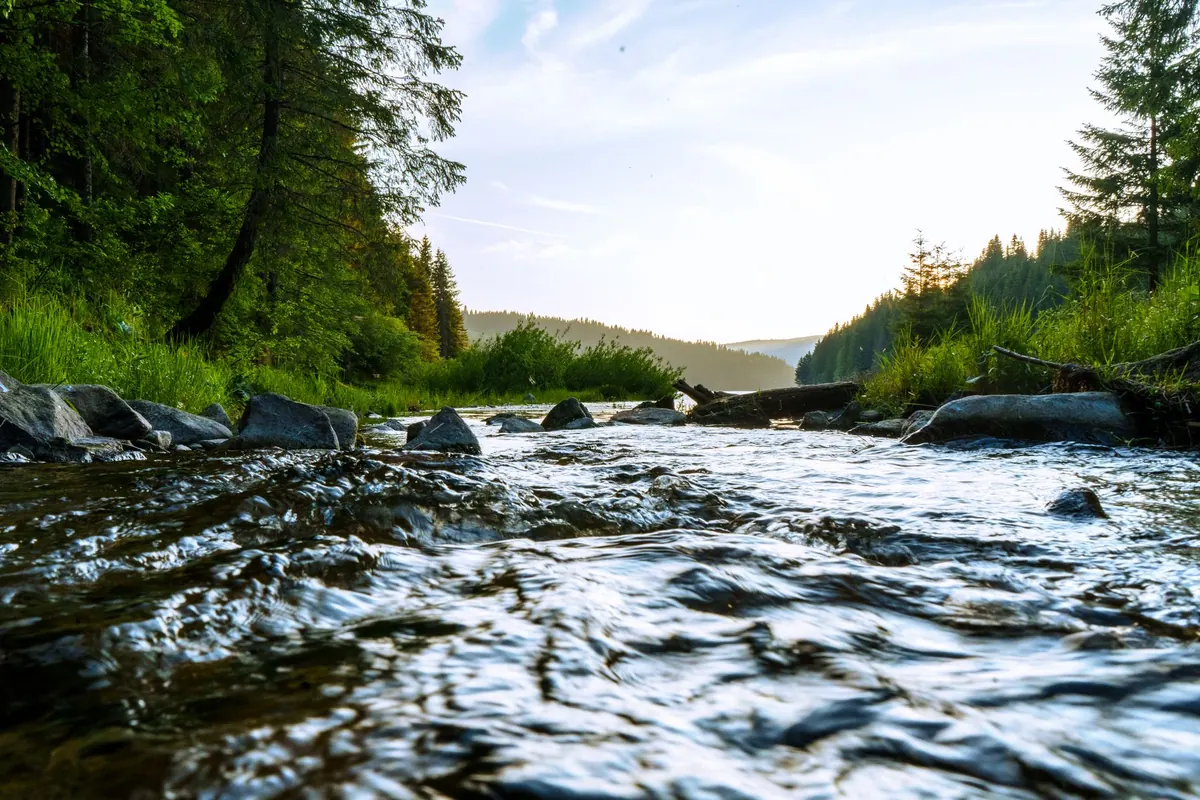
A river can look perfectly healthy and still fail its water quality tests. That is the uncomfortable truth behind a lot of headlines about English rivers. The water is clear, the banks are green, children are paddling — and the sample bottle comes back loaded with phosphate, or carrying bacteria that shouldn't be there at all.
Part of the confusion is that "water quality" isn't one thing. It's a bundle of measurements, taken at different times, in different places, for different reasons. Once you know what each test is looking for, the story of why so many English rivers fall short gets much easier to follow.
England's official framework looks at whole water bodies, not just a jar of water. It grades chemistry, biology, physical shape and flow from high down to bad, and a river can score well on one and badly on another. The headline grades usually hinge on a handful of measures:
So a river "failing" usually means it has missed the threshold on one or more of these. It rarely means the river is dead.
Most English sewers carry both domestic waste and rainwater. In a downpour, that combined flow can exceed what a treatment works can handle, so storm overflows are permitted to release diluted sewage into rivers to stop it backing up into homes. In theory that happens only in exceptional rainfall. In practice, company monitoring data has repeatedly shown thousands of spills a year, many in fairly ordinary wet weather. The overflows are legal points on a map; the frequency is the problem. A river can be dosed with sewage dozens of times in a season.
There's a quieter problem too. Even a well-run treatment works releases effluent containing phosphate, nitrate and traces of pharmaceuticals. In low-flow rivers — and much of eastern England is low-flow — that effluent can make up a substantial share of what's actually in the channel. Add a storm spill on top and the chemistry tips.
Sewage arrives through pipes. Farm pollution mostly doesn't. It comes as a thin, wide sheet of water moving across fields after rain, carrying soil, nutrients and sometimes slurry or pesticides with it.
Because it's diffuse, there is no single pipe to inspect and no easy culprit. Catchment work — buffer strips, cover crops, fencing streams off, better slurry storage — genuinely helps, but it depends on hundreds of individual decisions. That's why farm pollution is often called the biggest single reason English rivers miss their targets, and also the slowest to fix.
Most urban surface water drains don't go to a treatment works. They go to the nearest brook. Everything washed off roads and pavements goes with them: tyre and brake particles, which are a notable source of microplastics and metals such as zinc and copper; oil, fuel and combustion residues; road salt in winter; litter, dog mess and sediment from building sites.
Individually these are small. Multiplied across a town and concentrated by a gully, they add up. The first flush after a dry spell can be the dirtiest water a brook sees all month.
Water quality isn't constant. It shifts with rainfall, temperature, time of day and the state of the sewage network upstream. A sample taken on a dry Tuesday in June may look fine; the same spot on the Sunday after heavy rain can be a different river altogether.
Grab samples — the kind most volunteers and regulators take — are snapshots. They are useful and often damning, but they can't tell you what happened overnight. That's one reason continuous sensors, logging every few minutes, are spreading, and why invertebrate surveys stay so valuable: the bugs are an average, not a snapshot.
Regulators sample a fraction of England's rivers on a rolling programme, and volunteer groups cover some of the rest. They often know their local stretch better than anyone. Typical work includes:
Two honest caveats. Kit results vary — the same sample tested by three people can give three slightly different readings — so calibrate, follow the instructions and record your method. And a lone reading proves little. Patterns do. A year of records showing phosphate spiking after rain is far more persuasive than one bad number.
None of this fixes a river on its own. But the reasons English rivers fail are mostly known, mostly measurable, and mostly located some distance upstream of the sample bottle. Knowing which problem you're looking at is the first step to arguing for the right solution.
Photo: gusat silviu / Pexels